Publication: Art education and art-based methods in Polish schools in the context of integrating children with migration experience
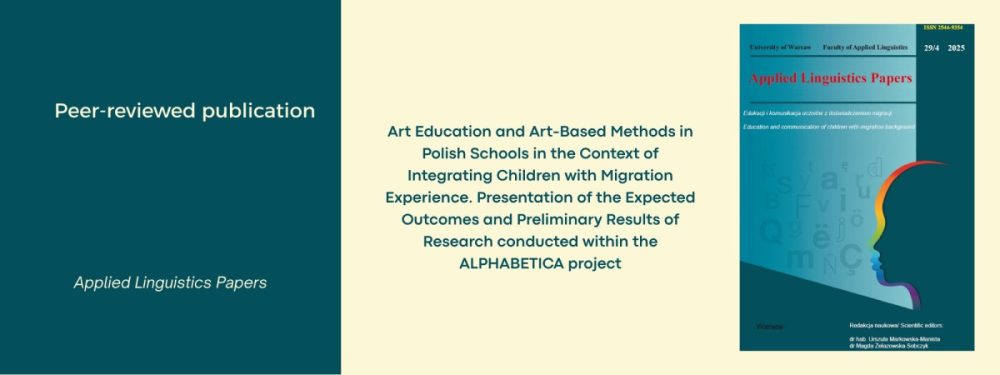
NewsThe ALPHABETICA partners at INTERKULTURALNI PL (Poland) have recently published an article in the journal Applied Linguistics Papers, examining the role of art-based educational methods in shaping and developing language and intercultural competences among students, particularly children with migration experience.
Art education plays an increasingly important role in building an inclusive, balanced, and empathetic school environment. Theatre, music, dance, visual arts, film, and digital storytelling can function as innovative pedagogical tools in multilingual and multicultural school environments, which can also serve as effective means of integrating children with a migrant background, especially by creating channels of non-linguistic and non-verbal communication.
This piece of research analyses in depth both the status of children with migration experience in Poland and the role of art education in the country, providing details of the evolution of migrant children’s presence in Polish schools as well as the changes introduced in the Polish curriculum in relation to arts education over the years. It also reviews initiatives aimed at strengthening art teachers’ competences and underscores the role of non-formal education in addressing gaps within the formal school system.
As part of the study, researchers conducted interviews in July 2025 with professionals working with children with migrant backgrounds in Polish schools and psychological-pedagogical counselling centres. The interviews explored the role of art and arts-based activities in education and cultural integration, as well as practitioners’ experiences using these methods to support children’s development and inclusion. While professionals with psychological or therapeutic training view arts-based approaches as a natural extension of their practice, experiencing the use of metaphors and symbols as better communication tools with all students, including children with special needs, they noted that many schoolteachers remain hesitant to apply such methods in regular classroom settings.
Overall, the findings point to the need for systemic changes in legislation, funding, teacher training, and educational policy to support the sustainable integration of arts-based education in Poland. Modern schools need structures that allow for the lasting and conscious inclusion of artistic activities in the learning process. The study calls for further empirical research on innovative, art-driven educational models that strengthen both language and intercultural competences in contemporary classrooms.