Results platform draft

cropped-alpha_icon.png

Welcome to the ALPHABETICA Results Platform!

Here you will find the main outputs produced within the project. Whether you are a researcher in the field of art-based education, a policymaker searching for recommendations for coherent and inclusive educational policies, or a teacher or educator looking for evidence of the transformative effects of the arts and/or guidance to implement activities to induce this change or foster civic engagement.

Find below different kinds of materials ALPHABETICA has prepared for you. You will see some general toolkits and lessons, which can be useful for anyone interested in the topic, as well as some more specific materials, according to the three pillars that have framed the activities of ALPHABETICA.
Glossary – Key terms at the core

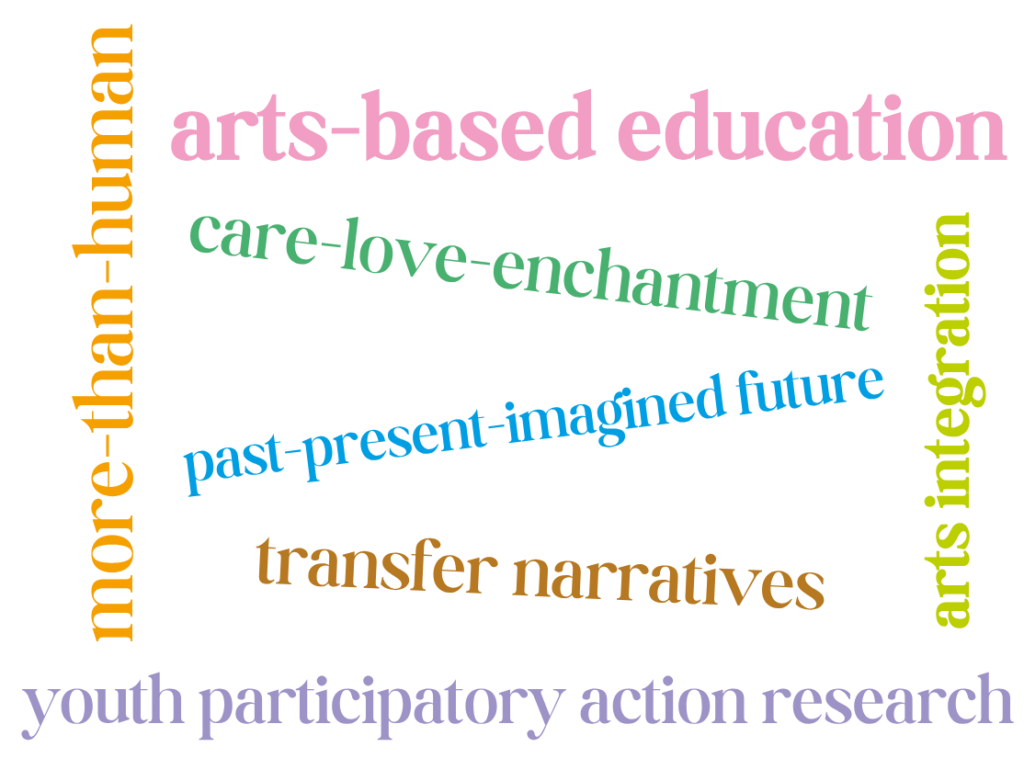
Arts-based education (ABE).

Educational approaches in which artistic processes and artefacts are primary vehicles for learning, development and meaning-making, not peripheral enrichment (Atkinson, 2007). ABE treats artistic practices and creative processes as primary vehicles for learning. It recognises that making, performing and curating generate forms of understanding that are not fully capturable by decontextualised tests. In the context of ALPHABETICA, ABE is a legitimate way to approach disciplinary concepts (for example through dance and drama for physical forces, collage and drawing for ecological cycles, spoken word for citizenship and history), to work with identity and memory, and to build social imagination. ABE is therefore both instrumental and intrinsic: it may improve academic outcomes when well designed, but, even when it does not, it still matters as a practice of human flourishing.

Youth Participatory Action Research (YPAR).

Cyclical inquiry led with and by young people, involving question formulation, co-design of methods, data collection and interpretation, and action on findings (Wright, 2015). In YPAR, children and young people are not research subjects; they are co-researchers and decision-makers. They formulate questions that matter to them, co-design methods, collect and interpret data, and act on findings. Within ALPHABETICA, the YPAR cycle is woven into studio routines: participants set intentions, document process and choices; co-analyse artefacts and experiences; decide what to share and with whom; and assess whether chosen actions produced the desired changes. This power-sharing is not symbolic. A participation register in each pilot documents who decided what, when, and on what basis, and how youth views were considered when adults retained responsibility (for example, on safeguarding or resource constraints).

Arts integration.

The deliberate connection of arts processes to disciplinary content and skills in other subjects, so that learning goals in both the arts and the target subject are pursued and assessed (Burnaford et al, 2007).

Pedagogies of care, love and enchantment.

Facilitation that foregrounds dignity, safety, predictable routines, warm feedback and attention to energy and embodiment as integral to learning (Carrol, 2018). Many participants in ALPHABETICA will have experienced exclusion, instability or stigma. Pedagogies of care, therefore, are not sentimental extras; they are core to ethical and effective practice. In concrete terms, facilitators enact care through predictable structures that lower anxiety; routines that welcome and close; warm feedback that is descriptive and forward-looking; invitations that validate multiple ways of knowing; and attention to energy, rest and embodiment. ‘Enchantment’ names moments of absorbed attention, wonder and joy that can reset expectations about what learning can feel like. These moments are deliberately cultivated through well-chosen exemplars, aesthetically inviting materials and spaces, and the permission to take creative risks without fear of ridicule.

Past-present-imagined futures.

A stance that legitimises memory-work and prospective imagination and connects them to action in the present (Bautista et al, 2016). Participants’ possibilities are shaped by their histories and their present realities. Poverty of resources can become poverty of hope when futures feel closed. ABE can open that horizon by legitimising imaginative work about possible worlds and by connecting it to action. In practice, this means deliberately weaving memory-work (photographs, family artefacts, places that matter) with present concerns and prospective planning (storyboards for changes participants want to see, youth-authored messages to decision-makers). This strand merges with YPAR’s action orientation and with Living Labs’ policy dialogues.

More-than-human.

Perspectives that attend to the agency of places, materials and non-human others in learning (Ylirisku et al, 2024). Learning happens with and through places, materials and nonhuman others. More-than-human perspectives invite participants to attend to ecologies and to the agency of materials (paper, pigments, clay, found objects, soundscapes, among others). Place-responsive prompts (such as walking maps, sound maps, textures and colours of a neighbourhood) create ways of knowing that exceed text, and that can be particularly enabling for multilingual classes or for learners with limited confidence in the language of schooling.

Publicness.

The degree to which artefacts and processes are shared beyond the immediate cohort; in ALPHABETICA, publicness is always opt-in and staged. Because arts-based work often culminates in artefacts or performances, the way publicness is handled is ethically significant. The default in ALPHABETICA is privacy; public sharing is opt-in at staged points. Roles (greeter, explainer, listener, note-taker) can be rotated to distribute visibility and responsibility. Captions are cowritten, balancing evocation and context. Audience responses are captured on cards that invite a concrete ‘one thing I will do differently’ prompt; these become data that can feed into Living Labs.

Audience dialogue.

Structured conversation with viewers or listeners designed as a learning opportunity for both participants and audience, with rehearsed roles and consent-aware facilitation (Samya, 2025).

Transfer narratives.

Short, concrete accounts by participants or adults of how an approach or repertoire travelled across contexts (Atkinson, 2007). At the end of a cycle or a term, participants are invited to harvest ‘transfer narratives’: short accounts of where a repertoire travelled/collaboration used in a different class, noticing that changed how someone moved through a park, warm feedback used in a sports or family context, a gallery-walk protocol adapted to a science laboratory. These narratives are a central part of the project’s claim about how ABE contributes to lifelong learning.

Setting up YPAR-based educational art activities

Theoretical and methodological toolkit 

Go deeper into ALPHABETICA’s shared standards for excellence, impact, and implementation, translating the project’s research design into a coherent set of guidelines, tips and steps for implementing diverse activities to widen equitable access to arts-based education for children and young people.

Guidelines and outputs from the three core ALPHABETICA pillars

Art education to combat
educational poverty

Transformative effects of arts

Foster civic engagement through art

Art education to combat educational poverty

Coming soon

Toolkit for teacher training

Lessons learned

Specific materials, outputs, guidelines, and tips from the pilot actions within this category

Transformative effects of arts

Coming soon

Lessons learned

Specific materials, outputs, guidelines, and tips from the pilot actions within this category

Foster civic engagement through art

Coming soon

Lessons learned

Specific materials, outputs, guidelines, and tips from the pilot actions within this category